
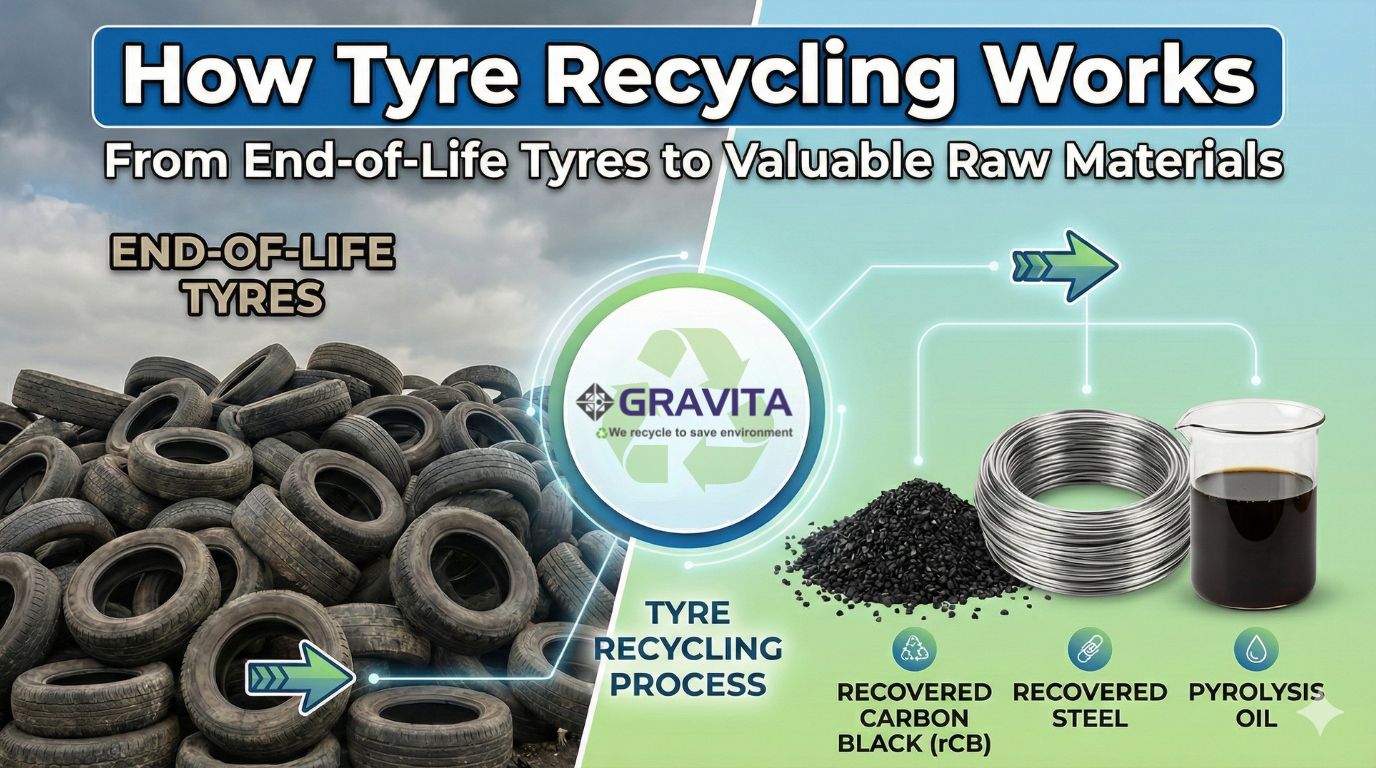
How Tyre Recycling Works: From End-of-Life Tyres to Valuable Raw Materials
Every year, millions of tyres reach the end of their usable life. They cannot be dumped in landfills and burning them is harmful to the environment. Tyre recycling solves this problem by converting end-of-life tyres into valuable raw materials that can be reused across multiple industries.
This article explains how tyre recycling works, step by step, and what useful materials come out of the process.
What Is Tyre Recycling?
Tyre recycling is the process of converting used or end-of-life tyres into reusable materials such as recovered carbon black, steel, oil, and rubber products. Instead of treating tyres as waste, recycling allows them to re-enter the industrial supply chain.
Tyres are complex products made of rubber, steel, and textiles. Because of this, they need specialized recycling methods rather than simple disposal or shredding.
Quick answer:
Tyre recycling turns waste tyres into raw materials that can be used again in manufacturing, construction, and energy applications.
Why Tyres Cannot Be Disposed Like Normal Waste
Tyres are classified as problematic waste for several reasons:
- They do not decompose naturally
- They trap gases and rise in landfills, damaging landfill liners
- They pose serious fire risks
- They can create breeding grounds for mosquitoes and pests
Because of these risks, many European countries restrict or ban landfill disposal of tyres. Recycling is the most responsible and sustainable solution.
How the Tyre Recycling Process Works
Tyre recycling follows a structured, controlled process. While technologies can vary, modern plants typically use advanced mechanical processing and thermal treatment to recover materials efficiently.
Below is a simplified step-by-step explanation.
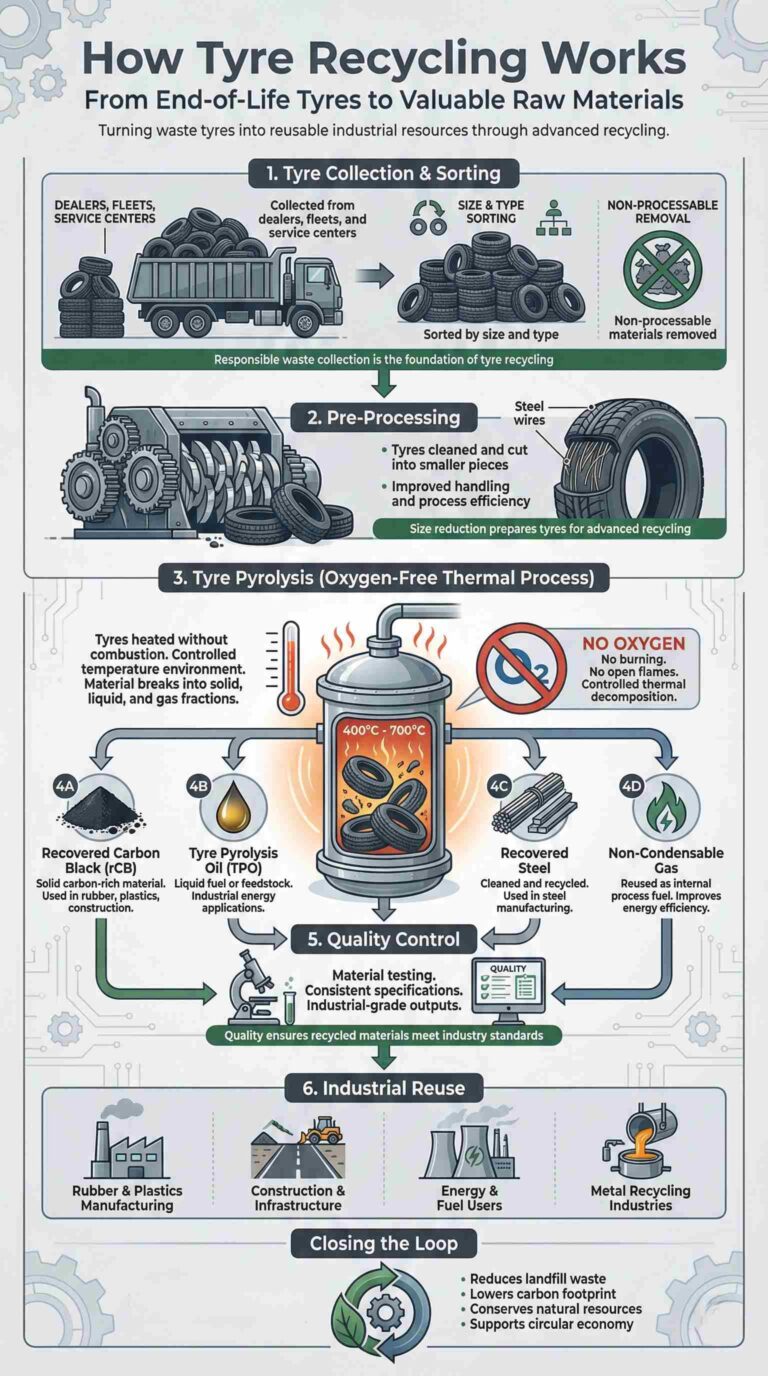
Step 1: Collection and Sorting of End-of-Life Tyres
The process starts with collecting tyres from:
- Vehicle service centers
- Tyre dealers
- Fleet operators
- Municipal collection points
Once collected, tyres are sorted based on size, type, and condition. Contaminated or unsuitable tyres are removed to ensure process safety and consistent output quality.
Step 2: Pre-Processing and Size Reduction
Before advanced recycling begins, tyres are prepared by:
- Removing dirt and foreign materials
- Cutting or shredding tyres into smaller pieces
Size reduction improves handling and allows uniform processing in the next stages. Steel components may also be partially separated during this step.
Step 3: Thermal Processing Through Tyre Pyrolysis
One of the most effective methods of recycling tyres is pyrolysis.
What Is Tyre Pyrolysis?
Tyre pyrolysis is a thermal process where tyres are heated in an oxygen-free environment. Without oxygen, the tyres do not burn. Instead, they break down into different usable components.
Quick answer:
Tyre pyrolysis uses heat, not combustion, to decompose tyres into oil, gas, carbon material, and steel.
How Pyrolysis Works
- Shredded tyres are fed into a sealed reactor
- The reactor is heated to high temperatures
- Tyre material decomposes into solid, liquid, and gaseous fractions
- Outputs are safely collected and processed further
This process is tightly controlled to meet environmental and safety standards.
Step 4: Recovery of Valuable Raw Materials
After pyrolysis, the tyre is no longer waste. It becomes several useful materials.
Recovered Carbon Black (rCB)
Recovered carbon black is a solid residue obtained after pyrolysis. It is refined and processed to meet industrial specifications.
Uses include:
- Rubber products
- Plastics and polymers
- Pigments and masterbatches
- Construction materials
Recovered carbon black helps reduce dependence on virgin carbon black and supports circular manufacturing.
Tyre Pyrolysis Oil (TPO)
Tyre pyrolysis oil is a liquid fraction produced during the process.
Common applications:
- Industrial fuel
- Feedstock for further refining
- Alternative energy applications
Its reuse reduces reliance on fossil-based fuels.
Recovered Steel
Steel wires embedded in tyres are recovered, cleaned, and recycled.
Uses include:
- Steel manufacturing
- Construction industry
- Metal processing plants
Recycling steel saves energy compared to producing new steel from iron ore.
Non-Condensable Gas
The gas generated during pyrolysis is often reused within the plant as an energy source, helping improve overall energy efficiency.
Step 5: Quality Control and Material Refinement
Each recovered material goes through quality checks to ensure:
- Consistent particle size
- Chemical stability
- Suitability for industrial reuse
This step is critical for meeting customer requirements and regulatory standards, especially in Europe.
What Are the Final Products of Tyre Recycling?
Direct answer:
Tyre recycling produces recovered carbon black, pyrolysis oil, steel, and energy gas.
These materials are supplied to industries such as:
- Rubber and plastics manufacturing
- Construction and infrastructure
- Energy and fuel users
- Metal recycling and steel plants
Environmental Benefits of Tyre Recycling
Tyre recycling offers clear environmental advantages:
- Reduces landfill and illegal dumping
- Lowers carbon emissions compared to virgin material production
- Conserves natural resources
- Supports circular economy goals in Europe
By converting waste into resources, tyre recycling closes the loop in material usage.
Why Tyre Recycling Matters for Europe
Europe has strict environmental regulations and ambitious sustainability targets. Tyre recycling supports these goals by:
- Ensuring responsible waste management
- Reducing dependency on imported raw materials
- Supporting local circular supply chains
For manufacturers, recycled tyre-derived materials also offer long-term cost stability and sustainability benefits.
Final Thoughts
Tyre recycling is no longer just a waste solution. It is a reliable source of valuable raw materials for modern industry. Through controlled processes like pyrolysis, end-of-life tyres are transformed into products that support manufacturing, energy production, and environmental responsibility.
As demand for sustainable materials grows, tyre recycling will continue to play a key role in Europe’s circular economy.